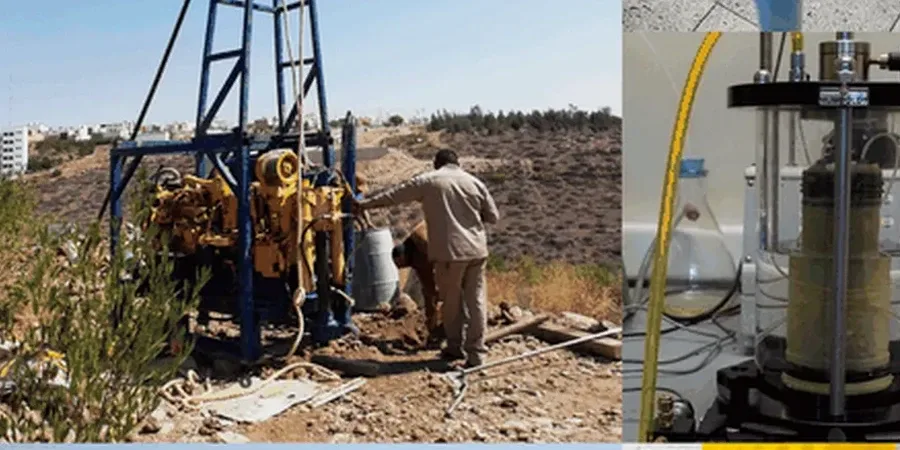
Moreno Valley’s rapid expansion east of the Riverside metropolitan area means contractors routinely encounter the full spectrum of Southern California geotechnical challenges, from the compressible alluvial deposits along the San Jacinto River corridor to the decomposed granite outcrops near Box Springs Mountain. A soil mechanics study becomes the single most cost-effective insurance policy a developer can purchase because it transforms guesswork about bearing capacity, settlement potential, and expansive clay behavior into quantifiable engineering parameters. The city sits at roughly 1,600 feet elevation within a tectonically active basin, and the California Building Code (Title 24) explicitly requires site-specific geotechnical data before a grading permit can be issued. Rather than treating the investigation as a compliance checkbox, the team approaches each Moreno Valley site as a unique depositional puzzle that must be solved through careful sampling, rigorous Atterberg limits determination, and consolidation testing that predicts how the soil column will behave under the sustained load of a warehouse slab or a two-story medical office building.
A soil mechanics study in Moreno Valley doesn't just classify dirt; it establishes the allowable bearing pressure that separates a code-compliant structure from a long-term liability.
Our approach and scope
A recent project on the eastern flank of the city, near the old March Air Reserve Base boundary, illustrates why standardized assumptions fail here. The surface soils appeared to be competent sandy loam, but undisturbed Shelby tube samples retrieved from eight feet down revealed a six-foot layer of high-plasticity clay with a liquidity index dangerously close to unity. Without a comprehensive soil mechanics study that included triaxial shear testing under consolidated-undrained conditions, the design team would have specified a conventional shallow footing system that would have experienced differential settlement exceeding one inch within the first wet season. The laboratory program quantified the preconsolidation pressure through oedometer tests, confirmed the effective friction angle via multi-stage triaxial compression, and provided the structural engineer with the modulus of subgrade reaction needed for a post-tensioned slab alternative. In Moreno Valley, where the groundwater table can fluctuate seasonally by more than fifteen feet depending on recharge from the Perris Basin aquifer, these laboratory-derived parameters are not academic exercises; they directly determine whether a building performs for 30 years or begins showing distress before the first tenant improvement is complete.
Local ground factors
The 2019 California Building Code, specifically Section 1803 of the IBC with Riverside County amendments, mandates that foundation design be based on a site-specific soil mechanics study whenever questionable soil conditions are present. In Moreno Valley, the intersection of active fault traces associated with the San Jacinto system and the presence of undocumented fills in older agricultural parcels makes this requirement more than procedural. A developer who proceeds with structural design using only a basic soil report without triaxial testing or consolidation analysis is exposed to liability under California’s SB 800 construction defect statute, which holds builders accountable for foundation performance for ten years. The real-world consequence of skipping comprehensive laboratory testing manifests as floor slab cracking in tilt-up industrial buildings when underlying expansive clays undergo seasonal volume changes, or as bearing capacity failure beneath heavily loaded column footings placed on loose alluvium that was never tested under saturated conditions. The insurance premiums for errors and omissions coverage reflect this risk profile, and carriers increasingly expect geotechnical recommendations to be backed by a full suite of index and engineering properties derived from a properly scoped soil mechanics study.
Common questions
What does a soil mechanics study cost for a typical Moreno Valley commercial lot?
For a standard commercial parcel in Moreno Valley requiring a drilling program of two to three borings, Atterberg limits, consolidation testing, and triaxial shear on selected samples, the soil mechanics study generally ranges from US$2,870 to US$5,100. The final cost depends on boring depth, number of samples tested, and whether groundwater monitoring or expansion index testing is added to the scope.
How is a soil mechanics study different from a standard geotechnical report?
A standard geotechnical report often focuses on field observations, blow counts, and basic classification. A soil mechanics study goes deeper into the laboratory phase, quantifying parameters like effective friction angle, preconsolidation pressure, compression index, and undrained shear strength through controlled testing. These numbers are essential when the structural engineer needs to model settlement precisely or when the building department requests performance-based justification for foundation design.
Does Moreno Valley have expansive soil problems that require specialized testing?
Yes. Many of the alluvial fan and basin deposits in Moreno Valley contain clay fractions derived from weathering of the granitic and metamorphic rocks in the Box Springs and Badlands areas. These clays can exhibit moderate to high expansion potential. A soil mechanics study includes swell-consolidation or free-swell testing to quantify this behavior so the design team can specify appropriate mitigation, whether that means over-excavation and recompaction, lime treatment, or designing the slab as a structurally suspended system.
How long does it take to get the laboratory results back?
Index property tests like moisture content and Atterberg limits can be completed within three to five business days. Consolidation tests require roughly one week per sample because each load increment must be held until primary consolidation is complete. Triaxial shear tests, depending on whether we run consolidated-drained or unconsolidated-undrained protocols, typically require seven to ten days. A complete soil mechanics study report for a Moreno Valley project, from drilling to final recommendations, usually takes three to four weeks.
Can the study address liquefaction potential for sites near the San Jacinto fault zone?
Absolutely. While liquefaction assessment is often treated as a separate analysis, our soil mechanics study incorporates the necessary index data, including grain size distribution and fines content, that feeds into simplified liquefaction triggering procedures based on Seed and Idriss methodology. For sites in Moreno Valley where the groundwater table is shallow enough to raise liquefaction concerns, we can integrate cyclic triaxial testing to directly measure the cyclic resistance ratio of the critical layers.