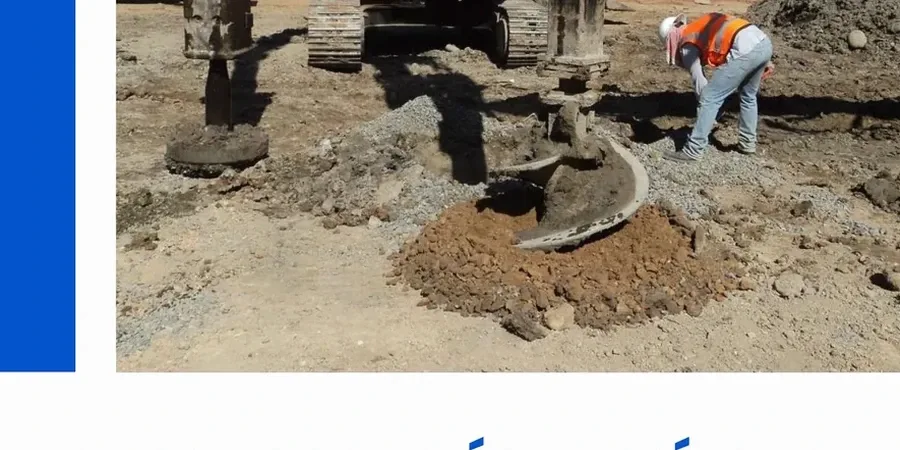
In Moreno Valley, we regularly see how the local alluvial deposits complicate shallow foundation work. The silty sands and soft clays left by ancient stream channels near the Box Springs and Badlands don’t respond well to standard compaction alone. A vibrocompaction approach can densify clean sands, but when fines exceed 15 percent, stone column design becomes the reliable path. We’ve applied it under warehouses along the 215 corridor and beneath retail pads near the Moreno Valley Mall, where settlement tolerances were tight. The logic is straightforward: install compacted gravel columns that reinforce the matrix, accelerate drainage, and transfer loads past the weak zone. Combined with a plate load test to confirm modulus, the design gives you predictable performance without over-excavating half the site.
A well-designed stone column grid transforms loose alluvium into a composite mass that settles uniformly rather than differentially — that is the difference between a trouble-free slab and a call-back.
Common questions
What does stone column design cost for a typical Moreno Valley warehouse pad?
For a commercial building pad in Moreno Valley, stone column design fees generally range from US$1,510 to US$5,980 depending on the treatment area, number of borings, and whether seismic analysis is required. A 100,000-square-foot warehouse with moderate liquefaction risk typically falls in the middle of that range.
How deep do stone columns need to go in the alluvial soils around Moreno Valley?
Column depth depends on the boring logs, but in the Moreno Valley basin we usually extend columns 25 to 40 feet to reach the older, denser alluvium or to pass through the liquefiable zone. We never terminate in a loose silt layer; the column base must bear on material with an SPT blow count above 15 to 20.
Can stone columns be used directly under spread footings?
Yes. We design the column grid so each footing is supported by a group of columns, with a load transfer platform of compacted granular fill bridging between column tops. Footing bearing pressure is then checked against the composite ground modulus confirmed by plate load testing.