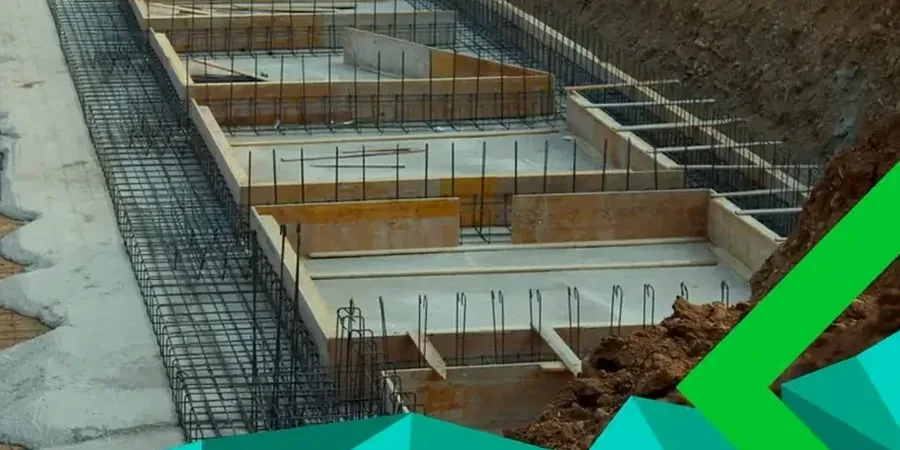
Moreno Valley shallow foundation designs must reconcile the IBC 2024 and ASCE 7-22 seismic provisions with the region's notoriously active alluvial soils. The city sits within a high-seismicity corridor just east of the San Jacinto Fault Zone, where spectral accelerations demand rigorous bearing capacity calculations and settlement analyses. Our team has worked across the Sunnymead and Box Springs areas, applying ASTM D1586 and D2487 protocols to characterize the granular deposits that dominate the Perris Valley plain. For structures on gentle slopes near Lake Perris, we often integrate slope stability assessments to confirm global stability before sizing footings. Because Moreno Valley's expansive clays can heave during wet winters and shrink in dry summers, every shallow foundation design we deliver incorporates moisture-conditioned strength parameters and a clear mitigation strategy.
In Moreno Valley, ignoring seasonal moisture fluctuation in clay soils can reduce allowable bearing capacity by 30 percent or more—our designs account for this directly.
Local ground factors
Our field crews deploy a truck-mounted drill rig with automatic SPT hammers to collect continuous split-spoon samples, which is the only reliable way to detect the thin, saturated sand lenses that can trigger seismic settlement in Moreno Valley. Without this level of subsurface resolution, a shallow foundation can experience angular distortion that cracks slab-on-grade floors and partitions. We also run downhole shear wave velocity tests to assign the correct Site Class—misclassifying a Site Class D profile as C leads to underestimated base shear and undersized footings. The biggest liability we see in the local market stems from builders who rely on prescriptive bearing values from outdated county maps instead of site-specific investigation. Our approach aligns with IBC 2024 Section 1803, which requires a geotechnical report for all structures in Seismic Design Category D, covering liquefaction potential, expansive soil swell pressure, and lateral earth pressure where retaining elements interact with the footings.
Relevant standards
IBC 2024 (International Building Code, Chapter 18), ASCE 7-22 (Minimum Design Loads for Buildings and Other Structures), ASTM D1586 (Standard Test Method for Standard Penetration Test), ASTM D2487 (Unified Soil Classification System), ASTM D1194 (Standard Test Method for Bearing Capacity of Soil for Static Load on Spread Footings), AASHTO T 99 / T 180 (Moisture-Density Relations of Soils)
Common questions
What does a typical shallow foundation design package cost for a single-family home in Moreno Valley?
For a standard residential lot in Moreno Valley, the geotechnical investigation and shallow foundation design typically ranges from US$1,660 to US$3,100. The final figure depends on access constraints, the number of borings required by IBC, and whether laboratory swell-consolidation testing is needed.
How deep do footings need to be in Moreno Valley's expansive soil areas?
We usually specify a minimum embedment of 24 to 36 inches to get below the active zone of seasonal moisture fluctuation. In areas mapped with high expansion potential, we may recommend deepened perimeter footings with underslab void forms to isolate the slab from heave.
Can you design a shallow foundation on a Moreno Valley lot with fill soil?
Yes, but it requires careful characterization. We run sand cone density tests and probe the fill thickness with test pits. If the fill is thin and properly compacted, we can bear on it. For deeper, uncontrolled fill, we evaluate overexcavation and recompaction or transition to a mat foundation to bridge soft zones.