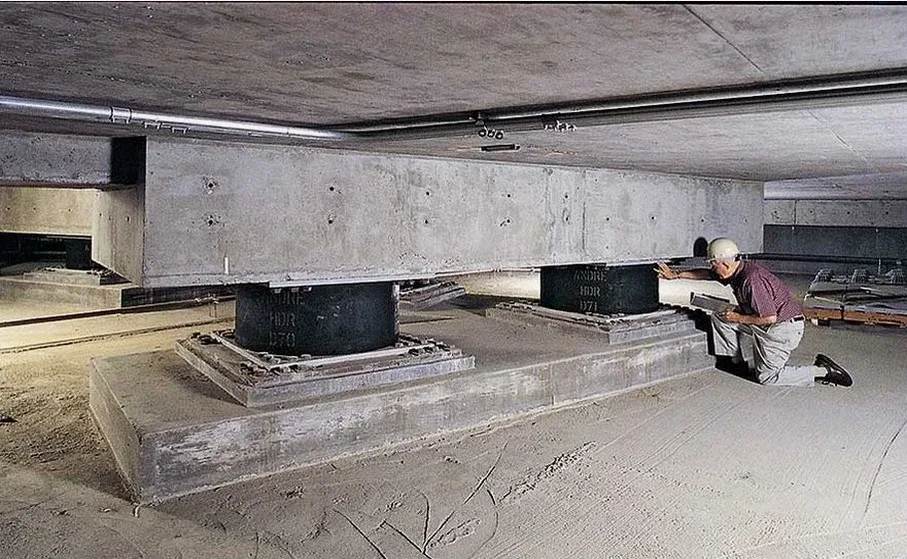
We recently reviewed a proposed medical office building near the Moreno Valley Mall where conventional fixed-base design showed excessive drift under the design earthquake. The site sits on alluvial fan deposits typical of the Perris Block, with groundwater at 80 feet and shear wave velocities around 280 m/s in the upper 30 meters. Base isolation seismic design changes the equation entirely—instead of forcing the structure to resist ground motion, we decouple it at the foundation level. The approach demands precise geotechnical input: dynamic soil properties, site-specific spectra, and bearing capacity under reduced vertical loads during lateral displacement. Our laboratory runs resonant column and cyclic triaxial tests on undisturbed samples to feed those parameters into the isolator selection process. For projects with irregular mass distribution, we also cross-check results with a liquefaction potential assessment to rule out strength loss in saturated lenses beneath the isolation plane.
A properly isolated building in Moreno Valley can see seismic forces reduced by 60 to 80 percent compared to a fixed-base counterpart—the key is getting the geotechnical stiffness right.
Local ground factors
Moreno Valley’s building stock grew rapidly in the 1980s and 1990s, long before the refined near-fault factors in today’s ASCE 7 were adopted. Many older structures were designed with force reduction factors that underestimated the pulse-like character of San Jacinto fault ruptures. Base isolation seismic design directly addresses this gap, but it introduces a new dependency: the geotechnical characterization must be more rigorous, not less. A common failure mode we see in peer reviews is underestimating the soil’s contribution to total system damping, which leads to oversized isolators and higher cost with no safety benefit. The opposite mistake—overestimating soil damping—can leave the superstructure underdamped and susceptible to higher-mode drift. We run sensitivity studies on both the upper-bound and lower-bound soil profiles per ASCE 7 Section 17.4.2, because the difference between those two bounds can shift the isolator displacement by four inches or more.
Common questions
How much does base isolation seismic design add to project cost in Moreno Valley?
For a typical mid-rise building in Moreno Valley, the geotechnical investigation, laboratory testing, and design engineering for base isolation range between US$4,280 and US$9,420 depending on the number of borings, depth to competent bearing stratum, and the isolator testing scope. The structural cost of isolators and the moat construction is separate and varies by manufacturer.
What soil conditions in Moreno Valley make base isolation a good choice?
Sites underlain by stiff alluvial soils with shear wave velocities above 250 m/s tend to perform well because the soil contribution to total system damping is moderate and predictable. The Perris Block geology in Moreno Valley often provides these conditions. Sites with very soft clays or liquefiable lenses require ground improvement before isolation becomes viable.
How does ASCE 7-22 handle near-fault effects for Moreno Valley projects?
ASCE 7-22 Section 17.4 requires a site-specific hazard analysis when the site is within 10 km of an active fault. Moreno Valley lies roughly 12 km from the San Jacinto fault trace, so near-fault factors are applied. We incorporate directivity effects into the target spectrum and run the isolator displacement calculation using the maximum considered earthquake (MCER) ground motions.
What laboratory tests are essential before specifying isolators?
At minimum we run resonant column or bender element tests to define Gmax and the modulus reduction curve, cyclic triaxial tests with strain levels matched to the expected free-field deformation, and consolidation tests to bound settlement under the isolation podium. If elastomeric bearings are planned, the manufacturer will also need site-specific temperature data—Moreno Valley’s summer extremes influence the compound formulation.