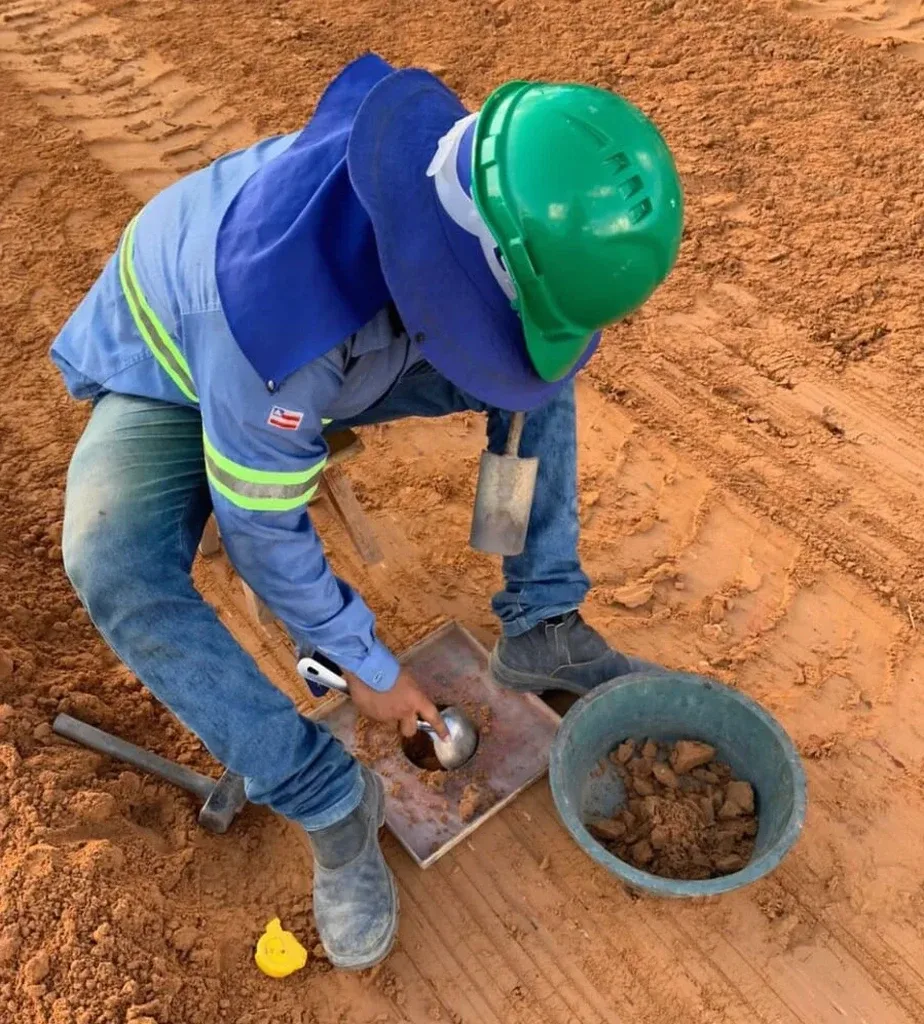
Moreno Valley sits at roughly 1,630 feet above sea level, on a landscape shaped by alluvial fans descending from the Box Springs and San Jacinto mountains. That elevation means rapid runoff during winter storms, which puts extra pressure on compacted pads and utility trenches. When the City of Moreno Valley building department reviews a grading permit, they expect proof that backfill achieves at least 90 to 95 percent relative compaction. Our field density test using the sand cone method provides that proof on the spot, without waiting days for lab results. We run the test in accordance with ASTM D1556 on residential slabs, commercial pad certifications, and roadway subgrades, delivering a pass-fail determination that keeps your earthwork crew moving. For projects where deeper stratigraphy matters, we often pair the sand cone with an SPT drilling program so the geotechnical report covers both shallow compaction and bearing capacity at foundation depth.
Compaction isn't just a number on a proctor curve—it's the difference between a pavement that lasts 20 years and one that alligators in five.
Local ground factors
The costliest mistake we see in Moreno Valley is a grading contractor who runs a nuclear gauge on fill that contains scattered rock fragments from the San Timoteo badlands formation, then wonders why the moisture reading doesn't match the oven-dry check. The sand cone method doesn't rely on nuclear backscatter or probe insertion, so it eliminates the lithology error that plagues indirect methods in heterogeneous fills. Skipping a density test altogether, or accepting a few low readings to keep the schedule, leads to differential settlement that shows up as cracked floor slabs, separated curb and gutter, or leaking utility trenches. When the City inspector catches it later, the rework cost is ten times what a proper test-and-reject cycle would have been during placement. We also cross-check any questionable result with a CBR test on the road subgrade when the site is part of a public street improvement, because compaction and bearing strength are not the same thing and both matter for pavement design life.
Common questions
What does a sand cone field density test cost in Moreno Valley?
A standard sand cone test in Moreno Valley typically runs between US$110 and US$130 per point, assuming reasonable site access and a full day of testing. The price includes the field measurement, moisture content determination, and a same-day pass-fail summary. If you need a formal stamped report or additional Proctor curves from our lab, those are quoted separately based on the number of soil types on site.
How many density tests does the City of Moreno Valley require?
The City generally follows IBC and Caltrans guidelines, which call for one field density test per 1,500 to 2,000 square feet of each compacted lift, or one test per 50 linear feet of utility trench backfill. The exact frequency depends on your approved soils report and the project-specific grading plan. We coordinate directly with the geotechnical engineer of record to match the testing frequency to the permit conditions.
Can you use the sand cone method in rocky fill or gravel?
The standard sand cone test works best in soils with particle sizes up to about 1½ inches. When the fill contains larger gravel or cobbles—common in alluvial deposits near the Box Springs foothills—we enlarge the test hole and apply a rock correction per ASTM D4718. If the oversize fraction exceeds roughly 30 percent, we often recommend supplementing with a plate load test or using a test pit inspection to evaluate compaction visually and mechanically.