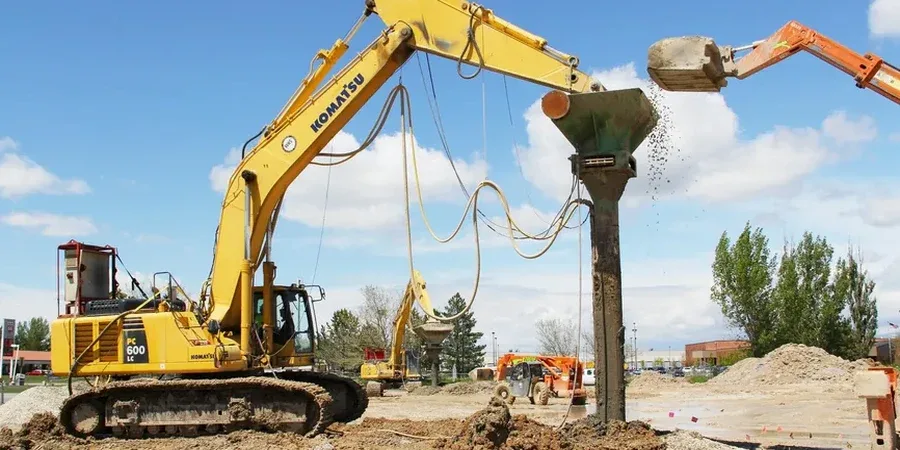
A warehouse project off Alessandro Boulevard hit refusal at 8 feet. The graded fill below was loose, poorly compacted by earthwork crews who skipped density testing. We saw immediate differential settlement in the slab mock-up. Our vibrocompaction design fixed it. We mapped the fill thickness with CPT soundings, identified zones below 70% relative density, and laid out a triangular grid at 7-foot spacing. The probe went to 25 feet, matching the fill depth. Post-treatment SPT values jumped from 6 to 22 blows. The warehouse floor passed the 1/480 deflection limit. This is how we approach vibrocompaction in Moreno Valley, where alluvial sands and uncontrolled fills create persistent ground improvement challenges. We combine ASTM D1586 data with ASCE 7 settlement criteria to deliver compaction plans that general contractors can execute without rework. Before densification, a CPT test helps profile the loose zones continuously, and we often cross-check results with sand cone density tests on the surface lift.
Loose alluvial fill in Moreno Valley can densify 30 percent with the right grid spacing and frequency, turning problematic soil into buildable ground.
Our approach and scope
Moreno Valley grew fast after the 1980s housing boom, pushing development onto the San Jacinto basin's alluvial fans. Much of the upper soil profile consists of silty sands and sandy silts that compact poorly under standard fill placement. Our vibrocompaction design addresses this by specifying probe type, grid geometry, and backfill gradation based on grain-size curves from the target layer. We pull samples at 5-foot intervals, run sieves under ASTM D6913, and adjust the vibrator frequency between 30 and 50 Hz depending on fines content. When the material has more than 12 percent passing the No. 200 sieve, we switch from dry top-feed to wet vibroflotation. The water jet helps rearrange silt particles and achieve uniform densification. Every design we issue for Moreno Valley sites includes a QA/QC table with minimum SPT N-values, maximum allowable settlement, and the required number of compaction points per 1,000 square feet. This level of detail comes from running hundreds of compaction jobs on the region's layered alluvium.
Common questions
How much does vibrocompaction design cost for a site in Moreno Valley?
Our design fees typically range from US$1,640 to US$5,810 depending on site size, fill depth, and the number of treatment zones. This covers the grid layout, technical specifications, and QA/QC acceptance tables.
What soil types work best with vibrocompaction?
Granular soils with less than 12 to 15 percent fines respond best. Clean sands and gravels densify efficiently. Silty sands may require wet vibroflotation or a modified grid with tighter spacing to reach target density.
How deep can vibrocompaction treat in Moreno Valley's alluvial soils?
Standard equipment reaches 50 to 60 feet. With extension tubes we can treat up to 80 feet. Most fills in Moreno Valley range from 10 to 30 feet, well within the practical depth range.
Do you verify compaction after treatment?
Yes. We run SPT tests at selected grid points, comparing pre- and post-treatment blow counts. For critical structures we add shear wave velocity testing to confirm liquefaction mitigation where required by IBC.