← Home · Foundations

Pile Foundation Design in Moreno Valley: Load Paths That Reach Bearing Strata

Together, we solve the challenges of tomorrow.

LEARN MORE →

The soil profile changes radically between the Box Springs benchlands and the flatter tracts south of Iris Avenue. Up near the hills you hit weathered granite within twenty feet. Down by March Air Reserve Base, the alluvial deposits run deeper and the groundwater table fluctuates with the season. A spread footing that works perfectly on decomposed granite can punch right through soft silts half a mile away. That difference defines why pile foundation design in Moreno Valley has to start with a honest look at what’s under the site. When shallow bearing is marginal, we take the load down to competent material with driven piles or drilled shafts, and we verify capacity with in-situ permeability data that tells us how pore pressure will behave during driving and under sustained load.

A pile that finds refusal in dense alluvium at thirty-five feet carries a different failure mode than one hanging in soft clay at eighteen feet.

Our approach and scope

A warehouse expansion off Heacock Street last year showed the pattern clearly. The first two exploratory borings hit dense alluvium at eleven feet, and the structural engineer penciled in a shallow mat. The third boring, only eighty feet east, found a lens of soft clay extending to twenty-three feet. That changed the conversation to deep foundations overnight. We ran a CPT test to track the clay lens continuously, then designed a driven H-pile grid with tip elevations set three diameters into the dense sand below the lens. Pile foundation design in Moreno Valley demands that kind of lateral resolution because the San Jacinto basin stratigraphy is simply too variable to interpolate from a couple of points. We also pull grain-size curves from the clay samples to confirm drainage behavior, because a pile group in low-permeability soil builds excess pore pressure that softens the shaft friction temporarily.
Pile Foundation Design in Moreno Valley: Load Paths That Reach Bearing Strata
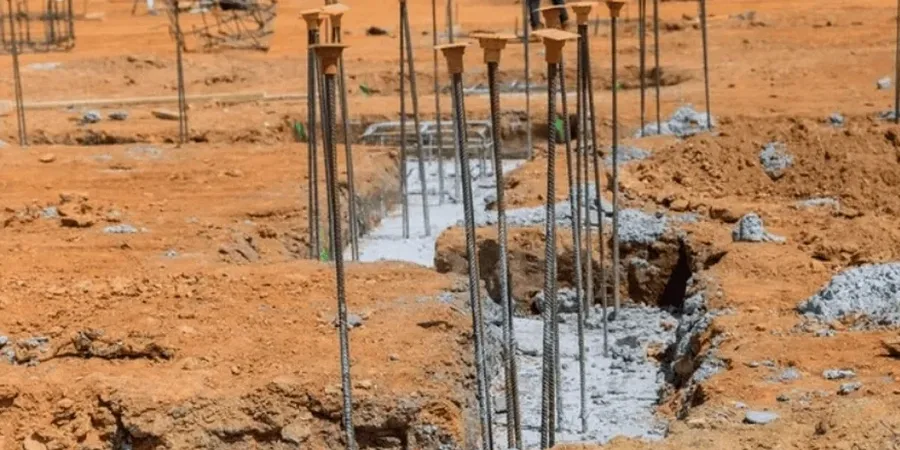
Technical reference image — Moreno Valley

Local ground factors

The mistake we see repeatedly in Moreno Valley is treating pile design as a structural-only exercise and skipping the geotechnical load test. A contractor submits a pile section based on a static formula from the report, drives a hundred piles, and then the PDA test on the first production pile shows half the predicted capacity. The problem is usually the beta coefficient used for shaft friction in the alluvial silts. Uncemented alluvium in this part of Riverside County loses skin friction fast when the pile is driven with even a small amount of remolding. Pile foundation design without a dynamic test on at least two indicator piles before production driving is a gamble. The correction involves either lengthening the pile or switching to a tapered section, and both options blow the budget if you find out after mobilization. We also run Atterberg limits on the cohesive layers because a PI above 30 signals that shaft adhesion will degrade further during seasonal moisture cycles near the surface.

Need a geotechnical assessment?

Reply within 24h.

Email: info@geotechnicalengineering1.com

Reference parameters

ParameterTypical value
Standard penetration resistance (N-value) at tip elevationN60 ≥ 30 blows/ft (dense sand or stiff clay)
Pile-to-pile center spacing2.5 to 3.5 pile diameters (group efficiency per IBC 1810)
Axial capacity verification methodHigh-strain dynamic testing (PDA) or static load test per IBC 1810.3.3
Lateral load criterionDeflection ≤ 0.5 inch at design lateral load (ASCE 7 Chapter 12)
Scour depth consideration (near Box Springs channel)Total scour depth added to unsupported pile length per HEC-18
Minimum pile embedment into bearing stratum3 pile diameters or 5 ft, whichever is greater
Concrete strength for cast-in-drilled-hole pilesf'c ≥ 4,000 psi (IBC 1810.3.9)

Related services

01

Driven Pile Foundation Design and PDA Testing

Design of H-pile, pipe pile, and precast concrete pile systems for commercial and industrial structures across Moreno Valley. We size the hammer, predict set per blow with wave equation analysis, and mobilize a Pile Driving Analyzer to confirm capacity on indicator piles before production driving starts.

02

Drilled Shaft and Cast-in-Drilled-Hole Pile Design

Design of reinforced concrete drilled shafts for sites where vibration from driven piles is unacceptable near existing structures, or where boulders in the alluvium require open-hole inspection. We specify casing depths, concrete placement method, and base cleaning procedure per IBC 1810.3.9.

Applicable standards

IBC 2024 (International Building Code) Chapter 18: Soils and Foundations, Section 1810 Deep Foundations, ASCE 7-22 Minimum Design Loads and Associated Criteria for Buildings and Other Structures, Chapter 12 Seismic Design, ASTM D1586 Standard Test Method for Standard Penetration Test (SPT) and Split-Barrel Sampling of Soils, ASTM D2487 Standard Practice for Classification of Soils for Engineering Purposes (Unified Soil Classification System), ASTM D4945 Standard Test Method for High-Strain Dynamic Testing of Deep Foundations, AASHTO LRFD Bridge Design Specifications (10th Edition) Section 10: Foundations

Common questions

What does pile foundation design cost for a project in Moreno Valley?

For a typical commercial or industrial building in Moreno Valley, pile foundation design including geotechnical investigation, engineering analysis, and construction-phase load testing runs between US$1,800 and US$6,860 depending on the number of piles, depth to bearing stratum, and whether a static load test is required in addition to dynamic testing. A small PEMB on twenty driven H-piles will be at the lower end; a larger structure requiring drilled shafts and a full-scale static test pushes toward the upper range.

How do you decide between driven piles and drilled shafts for a Moreno Valley site?

The decision turns on three factors. First, the depth to competent bearing. If dense alluvium or weathered granite is within fifty feet, driven H-piles are usually faster and cheaper. Second, vibration sensitivity. Drilled shafts eliminate the ground vibration of impact hammers, which matters near existing tilt-up buildings or sensitive equipment. Third, obstructions. In the alluvial fan areas near the Box Springs Mountains, boulders can deflect a driven pile; a drilled shaft lets us inspect the hole and remove obstructions before placing concrete.

What load testing do you require on pile foundations?

Per IBC 1810.3.3, we require dynamic testing with a Pile Driving Analyzer on at least two indicator piles per site, or more for larger projects. The PDA test measures force and velocity near the pile head during driving, giving us shaft resistance, toe resistance, and pile integrity in real time. If the structural load demands a higher confidence level or if the soil profile is highly variable, we specify a static load test where a reaction frame applies incremental load while we measure settlement. In Moreno Valley’s alluvial soils, we have seen static tests reveal setup effects where shaft friction increases 20 to 30 percent in the week after driving, which the PDA alone cannot capture.
Location and service area

We serve projects in Moreno Valley and surrounding areas.

View larger map