← Home · Slopes & Walls

Slope Stability Analysis in Moreno Valley: Geotechnical Risk & Engineering Solutions

Together, we solve the challenges of tomorrow.

LEARN MORE →

Moreno Valley's expansion from a quiet agricultural outpost into a logistics and residential hub placed heavy infrastructure directly on the ancient alluvial fans of the Box Springs and Badlands. The 1980s boom pushed grading into steep terrain without always accounting for the weak sedimentary contact zones beneath. Today, a slope failure on a single warehouse pad can cascade into millions in delayed shipments. Our team applies limit equilibrium and finite element methods specifically calibrated to the Pleistocene-age deposits found here. We don't run generic software outputs. The analysis integrates site-specific shear strength from local boreholes and often ties into a deeper seismic microzonation profile when the project sits within a liquefaction-susceptible alluvial basin.

A slope in Moreno Valley can hold a factor of safety of 1.5 in October and fail at 0.95 in February, purely from perched groundwater that never appeared on the initial boring logs.

Our approach and scope

A common mistake we see: contractors treat the near-surface sandy silts as uniform material and apply a single friction angle across the entire slope profile. That works until the first winter rains saturate the interface with the underlying claystone and the factor of safety drops below 1.0. Our analysis includes back-analysis of existing failures in the same geologic unit, drained and undrained strength envelopes, and transient seepage modeling for storm scenarios. We run probabilistic analysis to map failure probability across the slope face, not just a single deterministic number. For deep excavations adjacent to existing slopes, we combine the analysis with excavation monitoring to validate the design parameters during construction and adjust the reinforcement scheme if ground behavior deviates from the model.
Slope Stability Analysis in Moreno Valley: Geotechnical Risk & Engineering Solutions
Technical reference image — Moreno Valley

Local ground factors

The 2023 Tropical Storm Hilary dropped over 2 inches of rain on Moreno Valley in 24 hours, saturating cut slopes across the SR-60 corridor. Several shallow debris flows mobilized in the Reche Canyon area. The city sits at roughly 1,630 feet elevation with slopes underlain by the very fine-grained San Timoteo Formation, which loses significant strength when wetted. A stability analysis that only considers dry conditions misses the dominant failure mechanism here. We model the critical wetting front depth and pore pressure buildup to capture the transient loss of suction. The IBC classifies much of the hillside terrain as Seismic Design Category D, requiring explicit evaluation of earthquake-induced slope displacement using Newmark sliding block analysis or fully coupled dynamic models.

Need a geotechnical assessment?

Reply within 24h.

Email: info@geotechnicalengineering1.com

Video overview

Reference parameters

ParameterTypical value
Analysis MethodsLEM (Spencer, Bishop), FEM (SSR), Probabilistic
Design CodeIBC 2024, ASCE 7-22, Caltrans Geotechnical Manual
Minimum Static FoS1.5 (permanent), 1.3 (temporary cut)
Seismic Coefficient (kh)Per ASCE 7-22 site-specific PGA mapping
Shear Strength InputTriaxial CIU/CID, direct shear, ring shear for residual
Groundwater ModelingSteady-state and transient seepage (SEEP/W)
Reinforcement DesignSoil nails, ground anchors, MSE walls, buttresses

Related services

01

Seismic Slope Displacement Analysis

Using the Newmark sliding block method calibrated with site-specific ground motions, we estimate permanent slope deformation under the design earthquake. The output is a performance-based assessment that tells the structural engineer whether the slope movement is compatible with the foundation system.

02

Stabilization Design for Fill and Cut Slopes

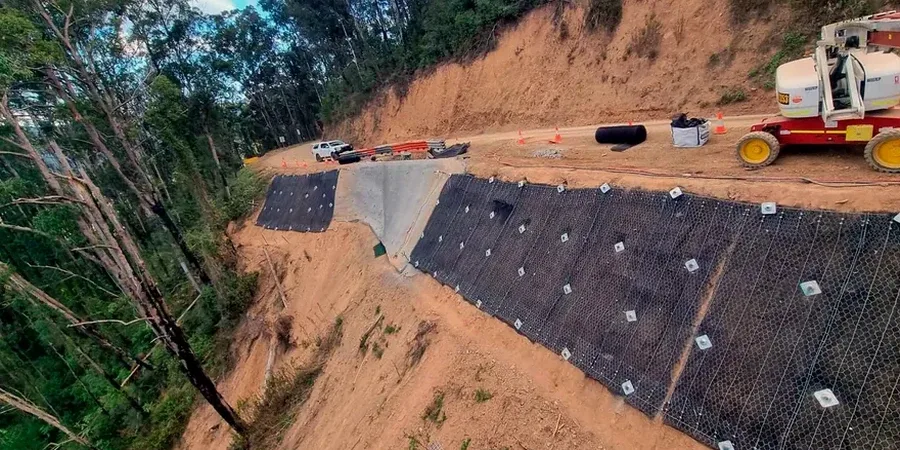
We design complete stabilization packages: high-tensile soil nails with shotcrete facing for steep cuts, mechanically stabilized earth (MSE) walls with geogrid reinforcement for fill embankments, and horizontal drains to depressurize perched groundwater zones in the San Timoteo Formation.

Applicable standards

IBC 2024 Chapter 18 (Soils and Foundations), ASCE 7-22 Minimum Design Loads for Buildings and Other Structures, ASTM D1586 / ASTM D2487, Caltrans Geotechnical Manual (Seismic Design), FHWA Geotechnical Engineering Circular No. 3 (Soil Nail Walls), California Geological Survey Note 48 (Slope Stability)

Common questions

How much does a slope stability analysis cost for a project in Moreno Valley?

The analysis typically ranges from US$1,290 to US$4,610 depending on slope height, complexity of the stratigraphy, and whether dynamic (seismic) modeling is required. A simple static analysis for a single-family lot falls at the lower end; a full 3D finite element model with Newmark displacement analysis for a commercial pad pushes toward the upper end.

What is the minimum factor of safety required for a permanent slope under IBC?

For permanent slopes under static conditions, the IBC and local Moreno Valley grading ordinance require a minimum factor of safety of 1.5. For temporary construction cuts, 1.3 is acceptable. Under seismic loading, the analysis shifts to a displacement-based criterion: permanent deformation must not exceed limits set by the structural engineer, typically 1 to 3 inches for building foundations.

When is a seismic slope stability analysis mandatory in Moreno Valley?

It becomes mandatory when the project is in Seismic Design Category D or higher, which covers most hillside areas in Moreno Valley where the site class is D or E. Any slope exceeding 15 feet in height, supporting a structure, or adjacent to a public right-of-way will trigger the requirement for a Newmark-type analysis per ASCE 7-22 and the California Building Code.
Location and service area

We serve projects in Moreno Valley and surrounding areas.

View larger map