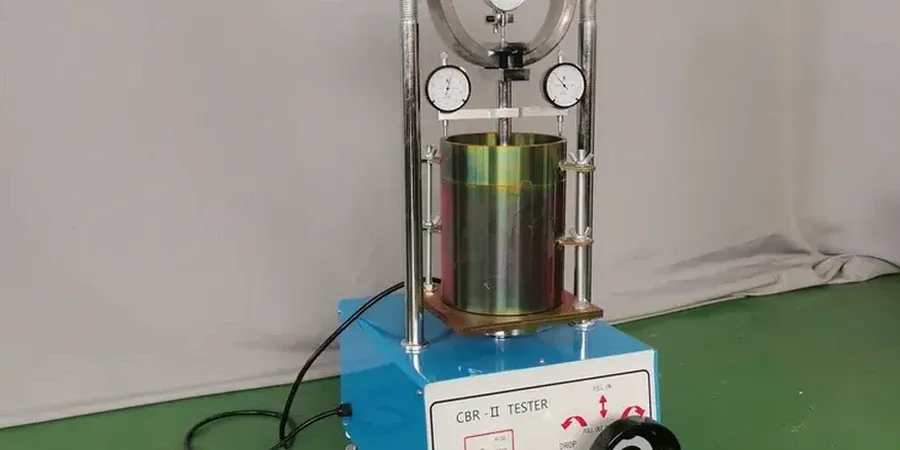
Moreno Valley sits on a complex alluvial fan where the Pleistocene-age Bautista Formation and younger Holocene deposits mix in ways that make subgrade performance unpredictable. For any pavement design that must comply with the latest Caltrans Highway Design Manual and IBC Chapter 18 requirements, a field density check alone is not enough. The sand cone density test can confirm compaction percentages, but only a laboratory CBR test according to ASTM D1883 reveals how that compacted soil will actually behave under traffic loading after seasonal moisture changes. Our laboratory processes samples from Moreno Valley's arterial corridors — from Alessandro Boulevard to the SR-60 industrial spine — because we know the expansive silts in the Box Springs area can lose over 60% of their dry strength when soaked. Getting the soaked CBR value right before the asphalt goes down is what separates a 20-year pavement from one that rutts in three seasons.
A soaked CBR value below 3% in Moreno Valley subgrade means the pavement section must be redesigned — no amount of additional compaction will fix a fundamentally weak soil.
Common questions
What is the minimum soaked CBR value required for residential streets in Moreno Valley?
The City of Moreno Valley Public Works Department generally requires a minimum soaked CBR of 6% at 95% relative compaction for residential street subgrade. If the native soil cannot meet this value, the project must either over-excavate and replace with import fill or stabilize the subgrade with lime or cement. The exact requirement may vary based on the pavement structural section and traffic index, so we recommend confirming with the project's geotechnical engineer before finalizing the earthwork specification.
How much does a laboratory CBR test cost for a Moreno Valley project?
A standard 3-point soaked CBR test (three specimens at different moisture contents) typically ranges from US$130 to US$220 per test point, depending on whether a separate Proctor compaction curve is needed and the number of points required for the pavement design. Projects with multiple subgrade types may need several test points to characterize the entire site.
How long does it take to get CBR test results from the lab?
The full soaked CBR test requires a minimum of 5 to 7 working days from sample delivery to final report. The 96-hour soaking period is mandatory per ASTM D1883, and the compaction, loading, and data reduction add another two to three days. We can provide preliminary unsoaked results within 48 hours if the client needs early-stage guidance, but the soaked values are the ones that govern the pavement design.
Can you run a CBR test on aggregate base material, or only on subgrade soil?
Yes, ASTM D1883 applies to both fine-grained subgrade soils and unbound granular base and subbase materials, though the compaction method and moisture conditioning may differ. For crushed aggregate base used in Moreno Valley pavement sections — typically Caltrans Class 2 or Class 3 aggregate — we compact the material in a 6-inch mold using modified Proctor effort and test it soaked to confirm it meets the minimum CBR of 80% specified for base course.