← Home · Laboratory

Advanced Triaxial Testing in Moreno Valley for Geotechnical Certainty

Together, we solve the challenges of tomorrow.

LEARN MORE →

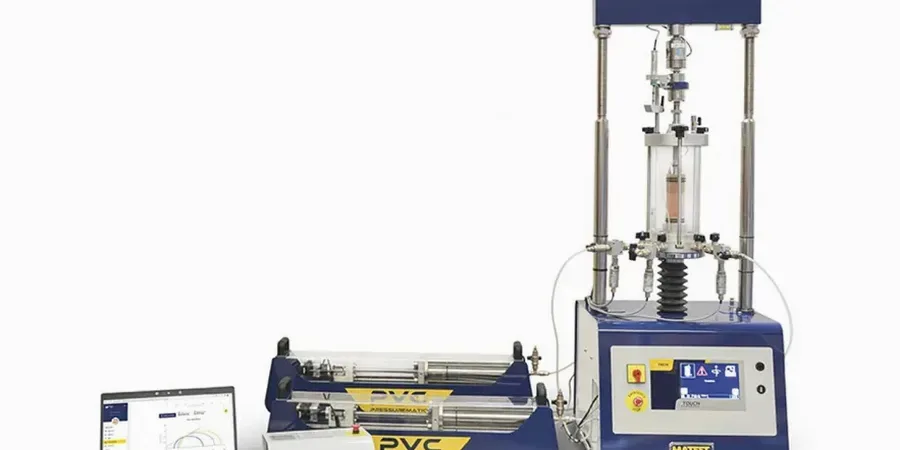
The mistake we see from Moreno Valley contractors is ordering a simple direct shear when the geology screams for a triaxial test. The difference matters. Much of the city sits on Pleistocene alluvial fans coming off the Badlands, with interbedded sands, silts, and gravels that don't give up their secrets to a single shear plane. Around the 60 freeway corridor where warehouse tilt-ups go up fast, we've pulled samples that looked fine in the split spoon and then failed at confining pressures that should have been comfortable. That is the moment where the triaxial test pays for itself, revealing the true friction angle and cohesion before you pour footings that may need to carry 4,000 psf on soil that only delivers 2,500. We run both consolidated-undrained (CU) and unconsolidated-undrained (UU) protocols depending on whether your Moreno Valley site drains freely or holds water after winter storms. The CPT test gives us a continuous profile, but when we need the actual strength envelope for foundation design, nothing replaces a properly run triaxial series.

A single triaxial test series gives you c and φ from three confining pressures. That is the difference between guessing and engineering a foundation.

Our approach and scope

Moreno Valley grew from a sparse ranching community into a logistics hub almost overnight in the 1980s and 1990s, and a lot of that early development skipped detailed shear strength testing. The result is older commercial pads near March Air Reserve Base showing differential settlement that could have been predicted with a triaxial test. We see this pattern repeat: contractors treat the alluvial soils as uniform when they are anything but. A triaxial test subjects a cylindrical specimen to controlled confining pressure while axial load increases to failure, generating the Mohr-Coulomb failure envelope that gives you cohesion (c) and friction angle (φ). Those two numbers drive bearing capacity equations and slope stability models. For a Moreno Valley site within the liquefaction susceptibility zones mapped by the USGS, combining a liquefaction assessment with triaxial data tells you not just whether the soil will liquefy, but how much post-liquefaction strength remains. We run three specimens per series at different confining stresses, because two points make a line but three make a real failure envelope. The lab follows ASTM D4767 for consolidated-undrained with pore pressure measurement, and ASTM D2850 for unconsolidated-undrained when the project schedule demands faster results.
Advanced Triaxial Testing in Moreno Valley for Geotechnical Certainty
Technical reference image — Moreno Valley

Local ground factors

Moreno Valley sits in a climatic sweet spot that is actually a geotechnical headache: hot dry summers baking the surface clays into brick, followed by short intense winter rains that turn silty layers into slurry. A triaxial test run on a sample taken in August will give you different effective stress parameters than one taken in February if the soil is not fully saturated during testing. That seasonal swing catches out-of-town engineers who do not account for the partial saturation effects common in the upper 10 feet of the San Timoteo Badlands-derived soils. The risk is under-designing retaining structures or shallow footings that perform fine for two dry years and then settle abruptly after a wet El Niño winter like 2023. We back-pressure saturate every CU triaxial specimen to a B-value above 0.95, ensuring the measured effective cohesion and friction angle represent the worst-case saturated condition. For Moreno Valley sites with deep groundwater near the 215 corridor, we also watch for contractive behavior in the silty sands: a drained test that shows strain-softening is a red flag for static liquefaction potential that no standard penetration test will catch.

Need a geotechnical assessment?

Reply within 24h.

Email: info@geotechnicalengineering1.com

Reference parameters

ParameterTypical value
Specimen diameter1.4 in or 2.8 in (undisturbed Shelby tube)
Confining pressures per series3 levels: typically 5, 10, 20 psi (adjusted to overburden)
Test standards appliedASTM D4767 (CU with pore pressure), ASTM D2850 (UU)
Failure criterionMaximum deviator stress or 15% axial strain
Measured parametersEffective cohesion c', effective friction angle φ'
Pore pressure measurementBack-pressure saturation with Skempton B-check >0.95
Typical soil types testedSaturated clays, silty sands, compacted fill, weathered bedrock
Report turnaround (standard)5-7 business days with stress-strain plots and Mohr circles

Related services

01

Consolidated-Undrained (CU) Triaxial with Pore Pressure

Full ASTM D4767 protocol with back-pressure saturation, B-check verification, and three-stage shearing. Delivers effective stress parameters c' and φ' for bearing capacity and slope stability analysis on saturated cohesive soils.

02

Unconsolidated-Undrained (UU) Triaxial for Rapid Turnaround

ASTM D2850 method for projects needing total stress parameters fast. Suitable for fine-grained soils where drainage during construction is negligible. Provides undrained shear strength for short-term excavation and footing design.

Applicable standards

ASTM D4767-11: Standard Test Method for Consolidated Undrained Triaxial Compression Test for Cohesive Soils, ASTM D2850-15: Standard Test Method for Unconsolidated-Undrained Triaxial Compression Test on Cohesive Soils, ASCE 7-22 Minimum Design Loads and Associated Criteria for Buildings and Other Structures, 2022 California Building Code (CBC) Chapter 18: Soils and Foundations

Common questions

When does a triaxial test make more sense than a direct shear test for a Moreno Valley site?

Triaxial is the right call when you need to control drainage conditions precisely, especially in saturated clays or silts where pore pressure response matters. Direct shear forces failure along a predetermined horizontal plane; triaxial lets the specimen fail along its natural plane of weakness. For the interbedded alluvial soils common in Moreno Valley, triaxial gives a more reliable failure envelope. You also get both undrained and drained parameters from a single CU series if you measure pore pressure.

What does triaxial testing cost for a single soil sample?

For a full three-specimen CU triaxial series run under ASTM D4767 with pore pressure measurement and stress-strain reporting, you are looking at a range of US$1,750 to US$2,610. The final number depends on whether we are working with undisturbed Shelby tube samples or remolded specimens, and how much back-pressure saturation time the material requires to hit B>0.95.

How many specimens do you need to run a complete triaxial series?

We run three specimens from the same sample at three different confining pressures to construct a Mohr-Coulomb failure envelope. Two points give you a line, but three confirm whether the envelope is actually linear. If the soil shows curvature, we may add a fourth specimen at a higher confining stress to capture the full range. For a typical Moreno Valley project, one undisturbed Shelby tube provides enough material for a full series plus a water content determination.
Location and service area

We serve projects in Moreno Valley and surrounding areas.

View larger map